
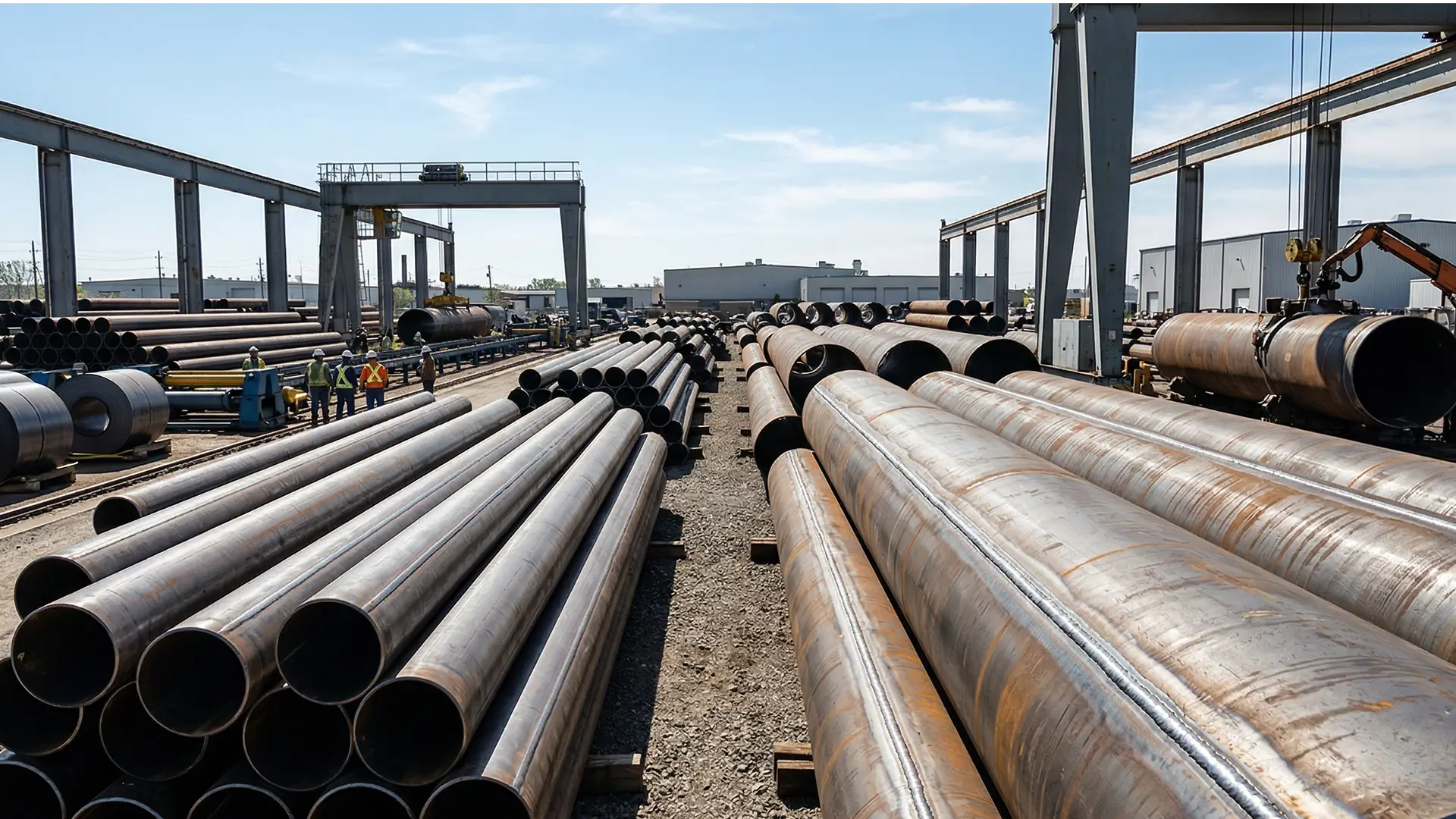
Let’s cut right to the chase: when an engineer stamps a drawing with a specific weld seam requirement, ignoring it is the fastest way to get your material submittal rejected and your project delayed.
In the world of structural steel pipe and heavy civil construction, the way a pipe is welded dictates its maximum pressure capacity, structural integrity, and overall cost. If you are sourcing carbon steel pipe for a high-pressure line, a mechanical casing, or deep foundation piling, you will inevitably have to choose between two dominant manufacturing processes: HFW (High-Frequency Welding) and DSAW (Double Submerged Arc Welding).
While both processes produce highly reliable, industry-standard carbon steel pipe, they are engineered for entirely different applications, wall thicknesses, and tolerances. Here is the complete, practical breakdown of DSAW vs. HFW pipe, how they are actually made in the mill, and when you should specify them for your next project.
What is High-Frequency Welding (HFW)?
High-Frequency Welding (HFW)—often grouped interchangeably in the field with ERW (Electric Resistance Welding)—is a highly efficient, high-volume manufacturing process used primarily for small to medium-diameter pipes.
How the Mill Makes It:
Unlike traditional manual welding that uses a consumable filler wire, HFW is a solid-state forging process. A massive flat steel coil is unrolled and continuously fed through a series of cold-forming rollers, bending it into a cylindrical shape. As the two edges meet, a high-frequency electrical current is passed through the steel. The natural resistance of the metal creates extreme localized heat, melting the edges. Mechanical pressure is then applied to forge the two edges together, creating a permanent, monolithic bond without any filler metal.
Why Buyers Choose HFW:
- Highly Cost-Effective: Because it operates continuously from a master steel coil at high speeds, HFW is incredibly economical for massive runs.
- Smooth Finish: The forging process leaves minimal flash (excess weld metal). This flash is usually trimmed away during production, leaving a smooth interior and exterior wall that is perfect for coatings.
- The Standard Workhorse: HFW is the absolute industry standard for most standard-wall ASTM A53 structural pipes, fencing frameworks, and smaller-diameter API 5L line pipe.
The Catch: HFW is generally limited to wall thicknesses of about 0.750” and outside diameters (OD) under 24 inches. Pushing past these dimensions requires a heavier approach.
What is Double Submerged Arc Welding (DSAW)?
When your project demands heavy-wall thickness, massive diameters, or extreme environmental tolerances, Double Submerged Arc Welding (DSAW) is the mandatory choice.
The Core Process:
Unlike the solid-state forging of HFW, DSAW utilizes a consumable filler metal. The longitudinal or spiral seam is welded twice—once on the inside diameter (ID) and once on the outside diameter (OD). The actual welding arc is buried under a protective blanket of granular flux, which cleans the molten pool and ensures a high-penetration, defect-free joint.
Why Engineers Specify DSAW:
- Unmatched Weld Integrity: The double-sided, flux-protected weld provides incredible deep-penetration strength, making it the non-negotiable standard for high-yield API 5L transmission pipelines and heavy offshore structural platforms.
- Extreme Dimensional Capabilities: Standard commercial U-O-E mill runs typically cover the 18.00” to 60.00” O.D. range. However, the DSAW process (specifically Spiral Weld or custom rolled-and-welded plate) can comfortably handle massive diameters exceeding 100 inches for heavy civil caissons and water transmission lines.
- Verifiable Quality Control: The distinct inner and outer weld beads are easily inspected using strict Non-Destructive Testing (NDT) methods like Ultrasonic Testing (UT) or X-Ray to ensure zero porosity.