
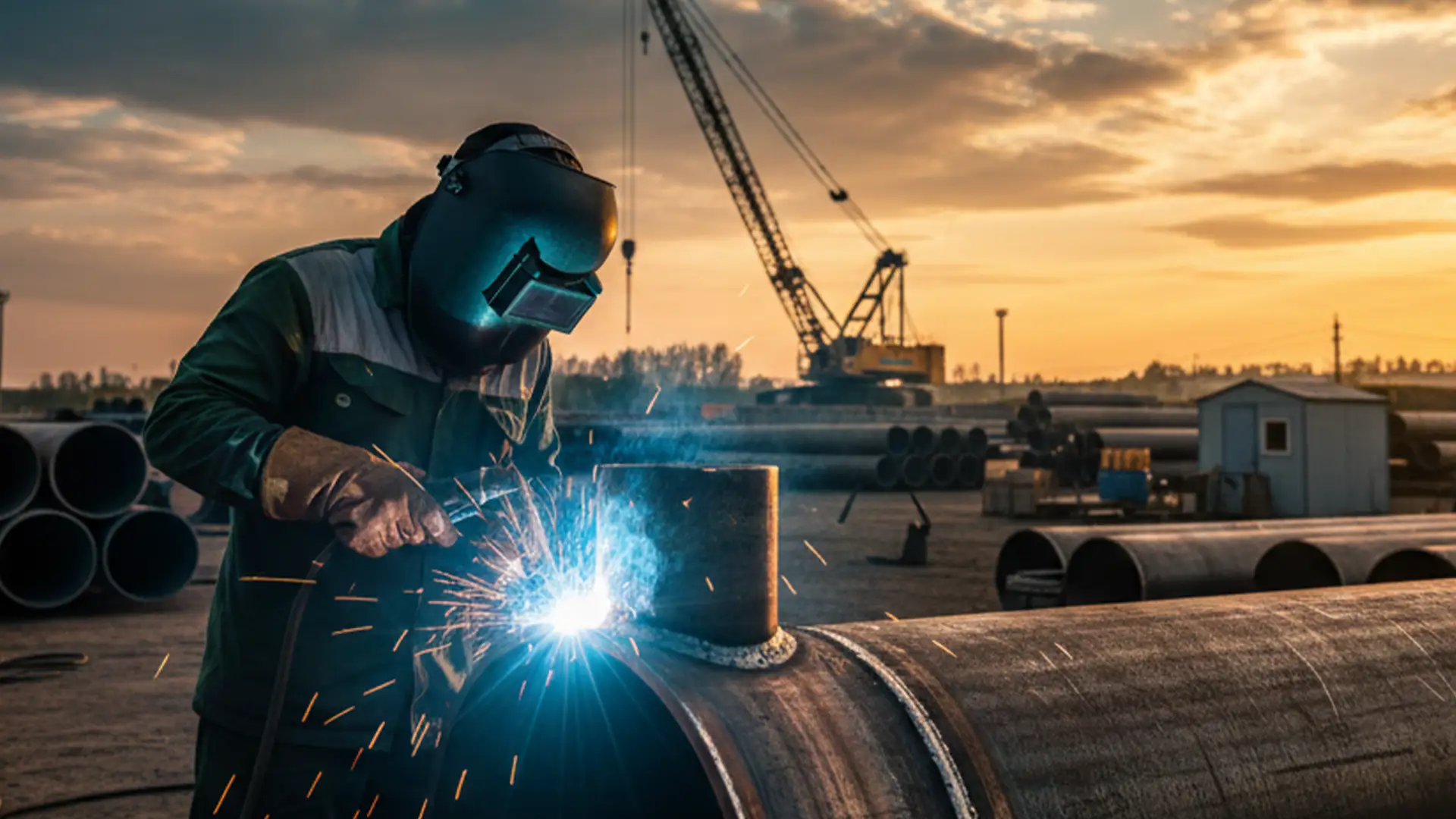
In structural steel fabrication, particularly when dealing with heavy wall pipe for critical applications like piling or structural frameworks, the integrity of every weld is paramount. This is where the AWS D1.1 Structural Welding Code comes into play, serving as the industry's cornerstone for ensuring reliable, high-quality welded joints.
AWS D1.1 provides a comprehensive set of requirements for welding carbon and low-alloy steels. It covers everything from design and pre-qualification to fabrication, inspection, and repair. For splicing heavy wall pipe, adherence to this code is not just good practice—it's often a contractual and safety requirement.
Why AWS D1.1 is Critical for Heavy Wall Pipe
Heavy wall pipe (typically defined as pipe with a wall thickness of 0.375 inches or greater) presents unique welding challenges. The sheer mass of the material, coupled with the need for full penetration welds to ensure structural continuity, demands precise control over the welding process.
Without proper procedures, issues like lack of fusion, cracking, excessive distortion, or incomplete penetration can severely compromise the pipe's load-bearing capacity. AWS D1.1 addresses these challenges by establishing rigorous standards that minimize defects and maximize the strength and durability of the welded connection.
Key Aspects of AWS D1.1 for Pipe Splicing:
- Pre-qualified Welding Procedures (PWP): For common joints and materials, AWS D1.1 offers pre-qualified procedures that have been tested and proven reliable. This saves time and cost by avoiding individual Procedure Qualification Record (PQR) testing.
- Procedure Qualification Record (PQR): For more complex or novel joint designs, materials, or welding processes, a PQR must be developed and tested. This involves welding test coupons, performing destructive and non-destructive testing, and documenting all parameters to prove the weld's integrity.
- Welding Procedure Specification (WPS): Based on either a PWP or a PQR, a WPS is a detailed written document providing specific instructions for the welder. It outlines essential variables such as welding process, base metal, filler metal, joint design, position, preheat temperature, interpass temperature, travel speed, and post-weld heat treatment.
- Welder Performance Qualification (WPQ): Even with a qualified WPS, the welder must demonstrate their ability to consistently produce sound welds by passing a WPQ test. This qualifies the welder for specific processes, positions, and material thicknesses.
Common Welding Processes for Pipe
Several welding processes are suitable for splicing heavy wall pipe under AWS D1.1, each with its own advantages and limitations:
1. Shielded Metal Arc Welding (SMAW - "Stick Welding")
SMAW is highly versatile, cost-effective, and suitable for field conditions due to its portability and lack of external gas shielding. It is commonly used for root passes and fill passes on heavy wall pipe. The specific electrode chosen (e.g., E7018) is critical for matching base metal properties and achieving desired mechanical characteristics.
2. Flux-Cored Arc Welding (FCAW)
FCAW is often preferred for its high deposition rates and ability to handle various positions, making it efficient for filling large groove welds in heavy wall pipe. It can be self-shielded (no external gas) or gas-shielded, offering flexibility in different environments.
3. Gas Metal Arc Welding (GMAW - "MIG Welding")
While primarily used for thinner materials or specialized applications, GMAW can be used for heavy wall pipe with proper procedures, especially in controlled environments. Its continuous wire feed allows for high productivity, but it requires external shielding gas.
4. Submerged Arc Welding (SAW)
SAW is an automated or semi-automated process offering very high deposition rates and excellent weld quality, particularly for circumferential seams on large diameter pipe in shop settings. It produces deeply penetrating welds and is ideal for long production runs.
The Importance of Preheat and Post-Weld Treatment
For heavy wall pipe, managing thermal cycles during welding is critical to prevent hydrogen cracking and excessive residual stress.
- Preheat: Applying heat to the base metal before welding raises its temperature, slowing the cooling rate of the weld metal and heat-affected zone (HAZ). This allows dissolved hydrogen to escape and reduces the risk of brittle fracture. AWS D1.1 specifies minimum preheat temperatures based on material thickness and composition.
- Post-Weld Heat Treatment (PWHT): For certain high-strength steels or extremely thick sections, PWHT may be required. This controlled heating and cooling process relieves residual stresses, improves toughness, and ensures the welded joint meets specified mechanical properties.
In conclusion, successful splicing of heavy wall pipe, especially for infrastructure projects, hinges entirely on meticulous adherence to AWS D1.1. It provides the framework for qualification, execution, and inspection, ensuring that every weld is not just visually appealing, but structurally sound and capable of meeting its design requirements over its operational lifetime.
Our network includes AWS-certified fabricators specializing in heavy wall pipe and structural steel. View welding services.
Related Technical Guides
Need Welding Services?
We connect you with certified fabricators in the industry
View Welding Companies