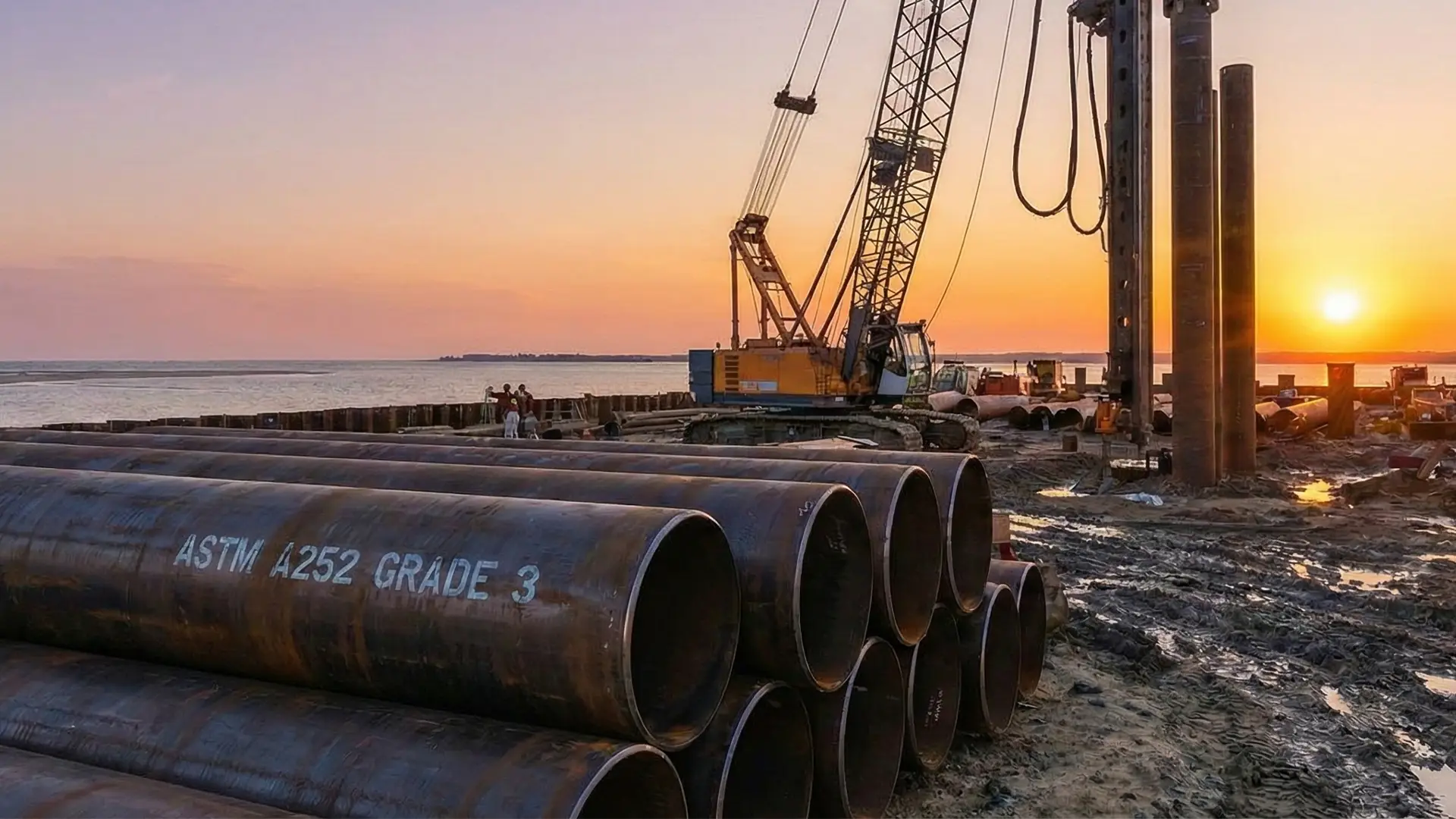
Steel Pipe Piles being driven
← Back to Library

ASTM A252 PILING

The standard specification for Welded and Seamless Steel Pipe Piles. Understanding Grades 1, 2, and 3.

ASTM A252 is the standard specification for steel pipe piles. It covers nominal (average) wall steel pipe piles of cylindrical shape and applies to pipe piles in which the steel cylinder acts as a permanent load-carrying member, or as a shell to form cast-in-place concrete piles.

Advertisement

The Three Grades

ASTM A252 defines three grades based on tensile and yield strength. Grade 3 is by far the most common in modern construction because it offers the highest strength-to-weight ratio.

Grade Min Yield Strength (psi) Min Tensile Strength (psi)
Grade 1 30,000 (30 ksi) 50,000
Grade 2 35,000 (35 ksi) 60,000
Grade 3 45,000 (45 ksi) 66,000

Manufacturing Types

ASTM A252 allows for three types of manufacturing. The choice depends largely on the diameter and availability.

  • Type S (Seamless): Extruded from a solid billet. Rare for piling due to high cost.
  • Type E (ERW): Electric Resistance Welded. Common for sizes 4" to 24". Has a straight longitudinal seam.
  • Type W (Spiral Weld): The most common for large diameter piling (24" to 144"). Has a helical seam.

A252 vs. A53/A500

Why use A252 instead of standard pressure pipe (A53) or structural tubing (A500)?

Piling FAQ

Since A252 Grade 3 only requires 45 ksi yield, many engineers need stronger steel. "Modified" often refers to pipe that meets Grade 3 minimums but has a higher yield (e.g., 50 ksi or 60 ksi) to match modern structural demands.
Yes, ASTM A53 Grade B (35 ksi) is often used for micro-piles or smaller diameter friction piles. However, it is weaker than A252 Grade 3 (45 ksi), so you may need a thicker wall to support the same load.
No. The standard ASTM A252 spec does not require Charpy V-Notch (impact) testing. If your project is in a very cold climate or subject to dynamic loads (like a bridge), the engineer must specify "CVN Testing" as an additional requirement.
Yes. While raw "black" steel is standard for driven piles (since friction wears off coating), piles used in marine environments or exposed structures are frequently Hot Dip Galvanized (ASTM A123) to prevent corrosion.
Testing. API 5L is for transporting hazardous oil/gas, so it requires rigorous hydrostatic and non-destructive testing (NDT). ASTM A252 is for structural support, so it focuses on tensile/yield strength and does not require hydro testing.
It can be either, but 95% of the time it is welded. Seamless pipe is generally too expensive for foundation work. Spiral Weld (SSAW) and ERW are the standard manufacturing methods for Grade 3 piling.
You often see pipe marked "API 5L X52 / A252 Gr 3". This means the pipe meets the strict testing of API 5L and the structural requirements of A252. This is excellent for piling because you get a higher quality, tested pipe.
Piles are spliced (joined) in the field using a full penetration butt weld. Backing rings (chill rings) are often used inside the pipe to ensure the weld penetrates fully without blowing through.
There is no theoretical limit, but transport is the bottleneck. Trucks can carry 60-80ft. Rail can carry 85ft. If you are near a port, we can ship spiral weld pipe in lengths over 100ft by barge directly to the job site.
Piling Calculator

Calculate the total weight and displacement of steel piles.

Weight Calculator
Advertisement
Advertisement
Advertisement