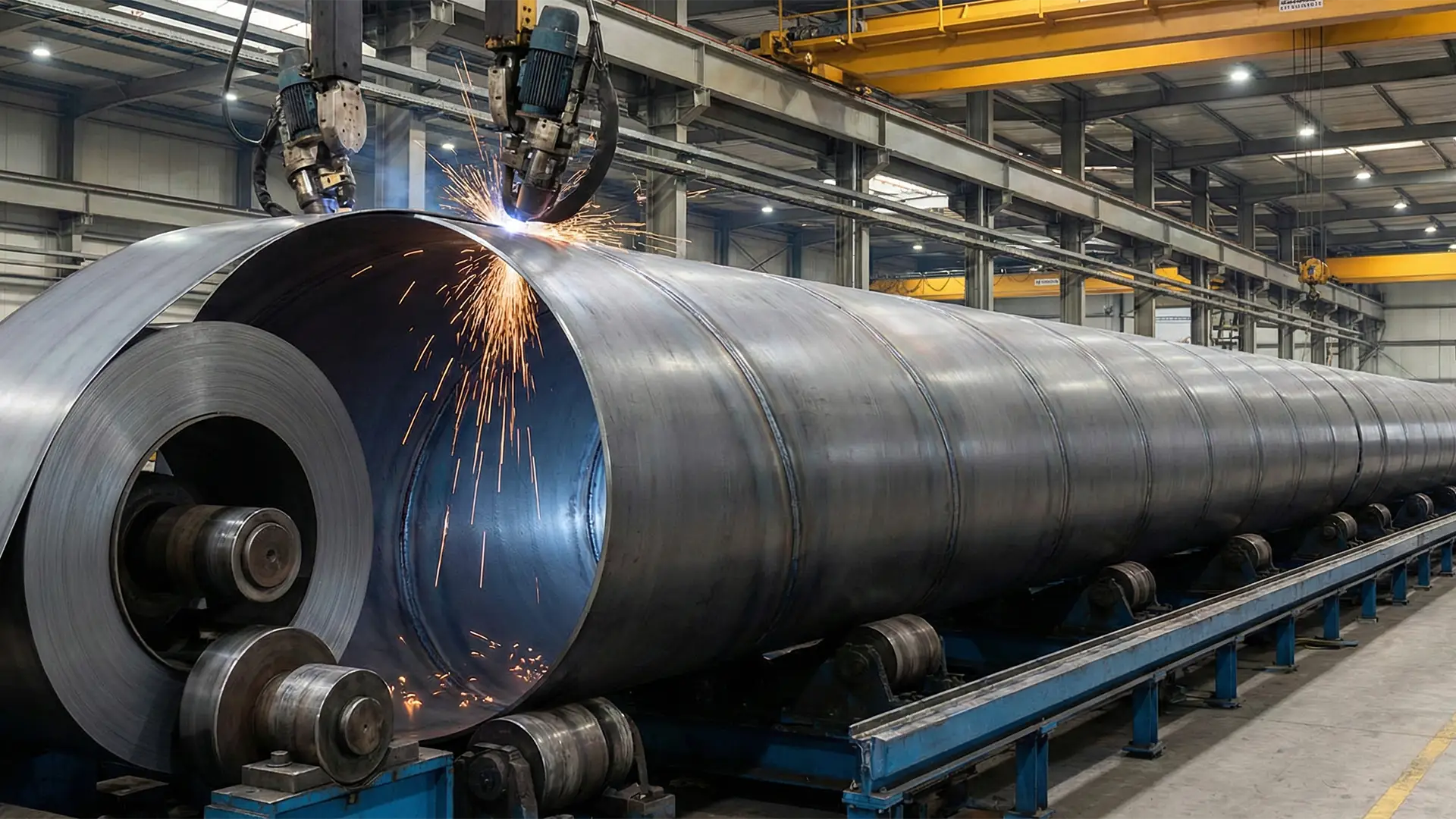
Spiral Weld Pipe Production
← Back to Library

SPIRAL WELD (SSAW)

The heavy-lifter of the piling world. Understanding Spiral Submerged Arc Welded pipe for large diameter applications.

When a project requires diameter sizes exceeding 24 inches—such as caissons for bridges, dolphin piles for ports, or casings for road boring—standard longitudinal weld pipe often becomes unavailable or prohibitively expensive. This is where Spiral Weld (SSAW) excels.

Advertisement

What is SSAW?

Spiral Weld pipe is manufactured using coils of steel plate. The coil is unwound and formed into a spiral shape (like a paper towel roll), and the edges are welded both inside and outside using the Double Submerged Arc Welding (DSAW) process.

Key Advantages

Diameter Flexibility

We can produce virtually any diameter (up to 144") by simply changing the angle of the spiral feed, without needing new tooling.

Unlimited Length

Since it is fed from continuous coils, spiral pipe can be produced in lengths up to 100ft+, limited only by transportation.

Structural Strength

The spiral seam acts as a stiffener hoop, providing excellent resistance to cracking and collapsing under soil pressure.

Common Size Ranges

Spiral weld is the industry standard for "Large OD" (Outer Diameter) applications.

Feature Specification Range
Diameter (OD) 18" up to 144"
Wall Thickness 0.250" up to 1.000"
Common Lengths 40ft, 60ft, 80ft (Splicing to 100ft+)
Typical Grades ASTM A252 Gr 2 & 3, API 5L Grade B

Spiral Weld FAQ

SSAW (Spiral) is made by winding a hot rolled coil into a helix. LSAW (Longitudinal) is made by bending a steel plate into a "U" then "O" shape with a single straight seam. SSAW is generally cheaper and available in larger diameters, while LSAW is preferred for high-pressure subsea applications.
Yes, absolutely. It is the industry standard for foundation piling (ASTM A252). The spiral weld seam acts as a "stiffener" along the length of the pipe, actually making it more resistant to buckling during driving than straight seam pipe.
Because it is fed from a continuous coil, the length is theoretically unlimited. In practice, we are limited by transportation. Trucking typically caps at 80 feet, but rail or barge transport allows for lengths over 100 feet without splicing.
Yes, it is often produced to API 5L standards for water, oil, and gas transmission. However, for critical high-pressure gas lines, many engineers prefer LSAW because the total length of the weld seam is shorter, reducing the statistical probability of a defect.
All SSAW pipe undergoes rigorous testing. The primary method is Ultrasonic Testing (UT), which scans the weld for internal flaws. We also use X-Ray (RT) for spot checks and Hydrostatic Testing to verify pressure holding capabilities.
It uses Hot Rolled Coil (which is produced efficiently in massive quantities) rather than discrete Steel Plate. Additionally, the manufacturing process is continuous and automated, resulting in higher production speeds and lower labor costs compared to the batch processing of straight seam pipe.
Advertisement
Weight Calculator

Need the weight per foot for large OD spiral pipe?

Calculate Now
Advertisement
Advertisement