
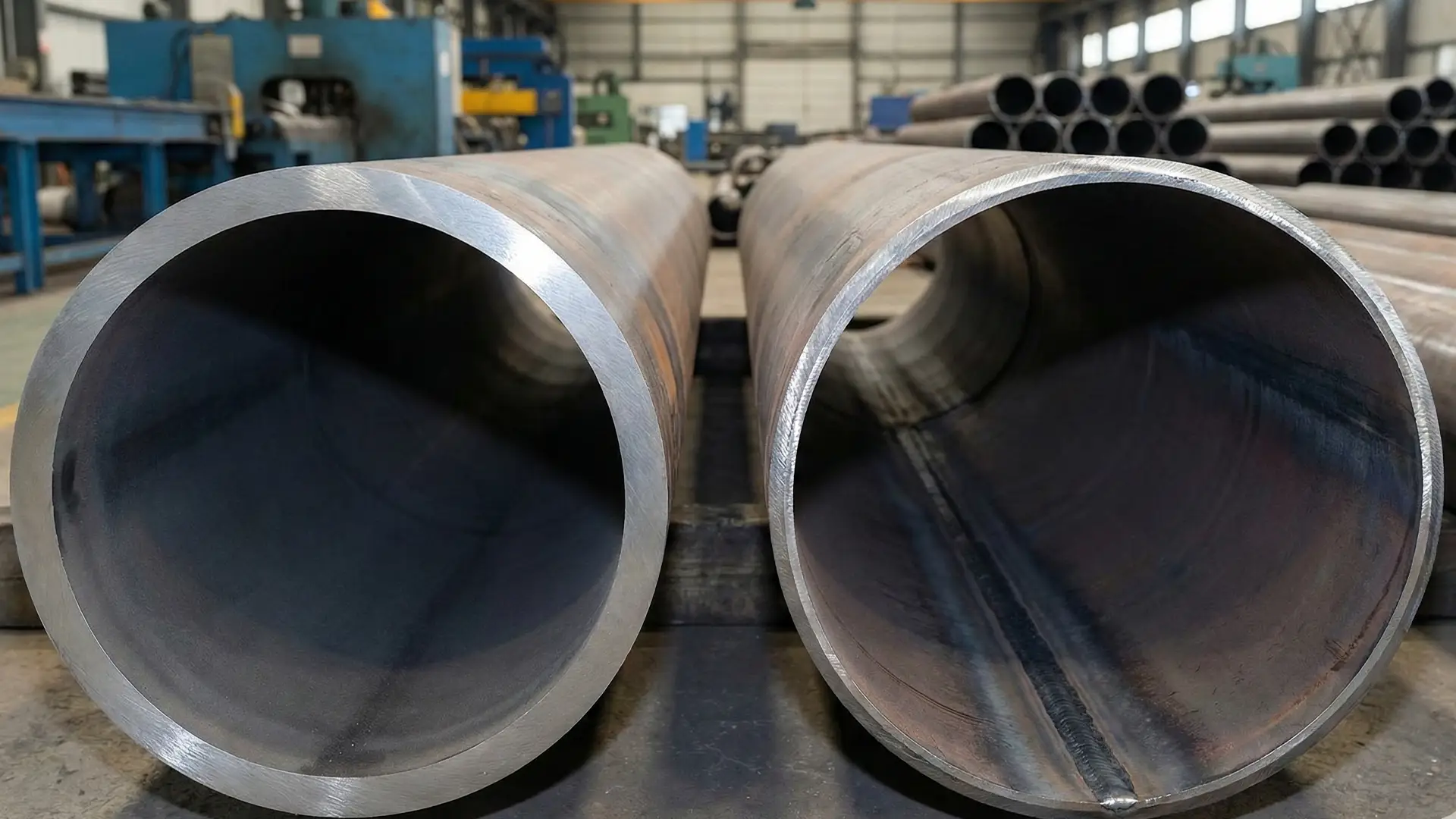
The debate between Seamless (SMLS) and Electric Resistance Welded (ERW) steel pipe is the most frequent technical hurdle for buyers. While both can be certified to meet ASTM standards, the manufacturing process creates two vastly different products with unique physical limits.
Choosing incorrectly can lead to two extremes: either overpaying for a high-pressure pipe where a standard welded option would suffice, or—worse—installing a welded pipe in a high-heat system where the seam could fail. This guide breaks down the engineering reality of **ASTM A106 Seamless vs. ASTM A53 ERW**.
1. Manufacturing: Force vs. Fusion
The core difference is in the steel's "memory." Seamless pipe is created by heating a solid billet and piercing it over a mandrel. The steel is essentially extruded into a tube. There is no seam because the pipe was never "joined"—it was always one piece. This results in a homogeneous grain structure that is uniform in strength across 360 degrees.
ERW pipe (Electric Resistance Welded) starts as a flat strip of steel (skelp) that is cold-formed into a cylinder. High-frequency electricity then fuses the edges together. While modern "normalizing" (heat treating the seam) makes this joint incredibly strong, the weld seam technically remains a "Heat Affected Zone" (HAZ) where the molecular structure of the steel differs slightly from the rest of the body.
2. The Engineering Penalty (Safety Factors)
In the world of pressure piping (ASME B31.3), engineers don't just look at wall thickness; they look at Joint Efficiency (E). Because seamless pipe has no weld, it is given a factor of 1.0. You get 100% of the calculated strength of the steel.
Welded pipe is often derated. For many high-consequence systems, engineers must apply an 0.85 multiplier to the pressure rating of an ERW pipe. For an estimator, this is the "tipping point." If a system requires a specific pressure, you might be forced to buy a thicker, heavier wall of ERW pipe to compensate for the 15% derating, which can actually make the "cheaper" welded pipe more expensive in terms of total weight and freight costs.
| Criteria | Seamless (SMLS) | Welded (ERW) |
|---|---|---|
| Common Spec | ASTM A106 / API 5L | ASTM A53 / A500 |
| Cost | Higher (Complex Process) | Lower (High Speed) |
| Concentricity | Lower (Mandrel Drift) | Higher (Fixed Wall) |
| Wall Thickness | Extreme (Heavy Wall) | Limited by Coil |
| Best Use | High Pressure / High Temp | Structural / Low Pressure |
3. Concentricity & Tolerance
Ironically, ERW pipe often has better **dimensional precision** than seamless. Because ERW is made from a flat-rolled steel sheet, the wall thickness is incredibly consistent. In a seamless mill, the piercing rod can drift slightly as it passes through the hot billet, leading to "eccentricity" where one side of the pipe is slightly thicker than the other.
If you are using the pipe for a precision mechanical part (like a roller or a structural column), the tight tolerances of ERW or DOM (Drawn Over Mandrel) tubing are often superior to the "rougher" tolerances of a mandrel-mill seamless pipe.
4. Making the Final Decision
So, which should you choose? It comes down to two questions:
- Is there extreme heat? If the line exceeds 750°F, you need the "Killed Steel" properties of ASTM A106 Seamless.
- Is there a potential for cyclic fatigue? In high-vibration or high-pressure-cycle environments, engineers prefer seamless to eliminate the risk of seam-split propagation.
For standard building services, low-pressure steam, or structural supports, ASTM A53 ERW is a perfectly reliable, cost-effective solution that is readily available from most North American pipe distributors.
Need Weight Comparisons?
Do you need to compare the weight of a Sch 80 Seamless pipe vs. a Standard Wall ERW pipe for your freight estimate?
Run the Calculator