
PIPE VS. TUBING: WHAT IS THE DIFFERENCE?
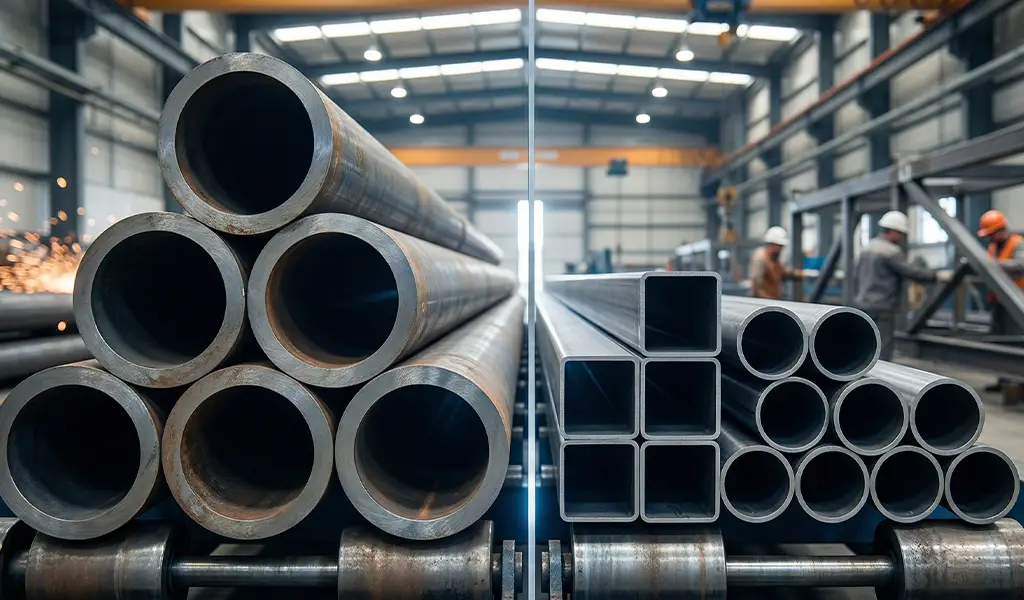
The terms "pipe" and "tube" are often used interchangeably on job sites, but in the steel industry, they are completely different products. They are manufactured to different tolerances, measured using different systems, and engineered for entirely different applications.
The Golden Rule
Pipe is a vessel designed to transport fluids or gases, so its defining measurement is its inside capacity. Tubing is structural, so its defining measurement is its exact outside dimensions and wall thickness.
1. How They Are Measured
The fastest way to tell if you are dealing with pipe or tubing is to look at how it is sized on the material test report (MTR).
Measuring Steel Pipe
- Measured by Nominal Pipe Size (NPS).
- "Nominal" means in name only. A 2" NPS pipe does NOT have an exact 2-inch outside diameter (it's actually 2.375").
- Wall thickness is defined by a Schedule (e.g., Schedule 40, Schedule 80).
Measuring Steel Tubing
- Measured by exact Outside Diameter (OD).
- A 2" steel tube measures exactly 2.000" across the outside.
- Wall thickness is measured in exact inches or decimal gauge (e.g., 0.250" wall).
2. Shape & Application
Because pipe is designed for the transportation of liquids and gases under pressure, pipe is only ever round. The round shape ensures even pressure distribution across the walls.
Tubing, on the other hand, is engineered for structural load-bearing and mechanical applications. Therefore, tubing can be manufactured in a variety of profiles, including:
- Round Tubing (HSS Round)
- Square Tubing (HSS Square)
- Rectangular Tubing (HSS Rectangle)
3. Manufacturing Tolerances
Because tubing is used in mechanical applications, OEM manufacturing, and architectural framing, it requires incredibly strict manufacturing tolerances for straightness, outside diameter, and wall thickness consistency. Pipe, being primarily a conduit, has much looser dimensional tolerances.
Quick Reference Comparison
| Feature | Steel Pipe | Steel Tubing |
|---|---|---|
| Primary Use | Transporting fluids and gases | Structural and mechanical load bearing |
| Shape | Strictly Round | Round, Square, Rectangular |
| Diameter Measurement | Nominal Pipe Size (NPS) | Exact Outside Diameter (OD) |
| Wall Thickness | Schedule (Sch 40, Sch 80) | Exact Decimal / Gauge (0.250") |
| Common Specs | API 5L, ASTM A53, A252 | ASTM A500, A513 |
Deep Dive: Pipe Manufacturing Methods
Now that you know you need steel pipe instead of tubing, the next step is determining how that pipe should be manufactured based on your pressure and structural requirements. Explore our technical guides below:
Need to Source Material?
Browse our supplier directories based on your exact engineering requirements.
Technical Library
Check Your Weights
Calculate exact weights for carbon steel pipe and HSS tubing.
Open Weight Calculator