
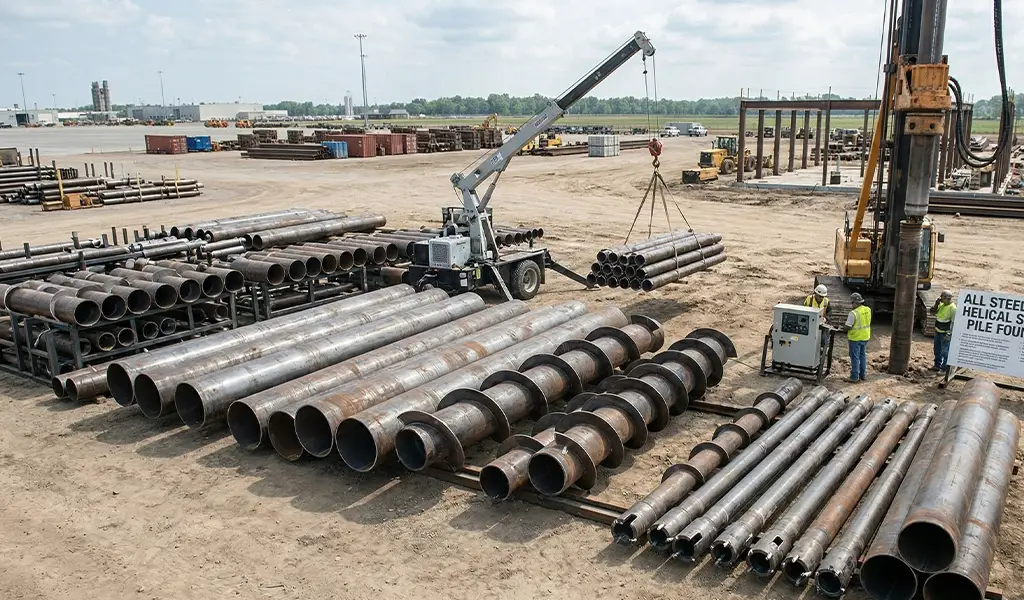
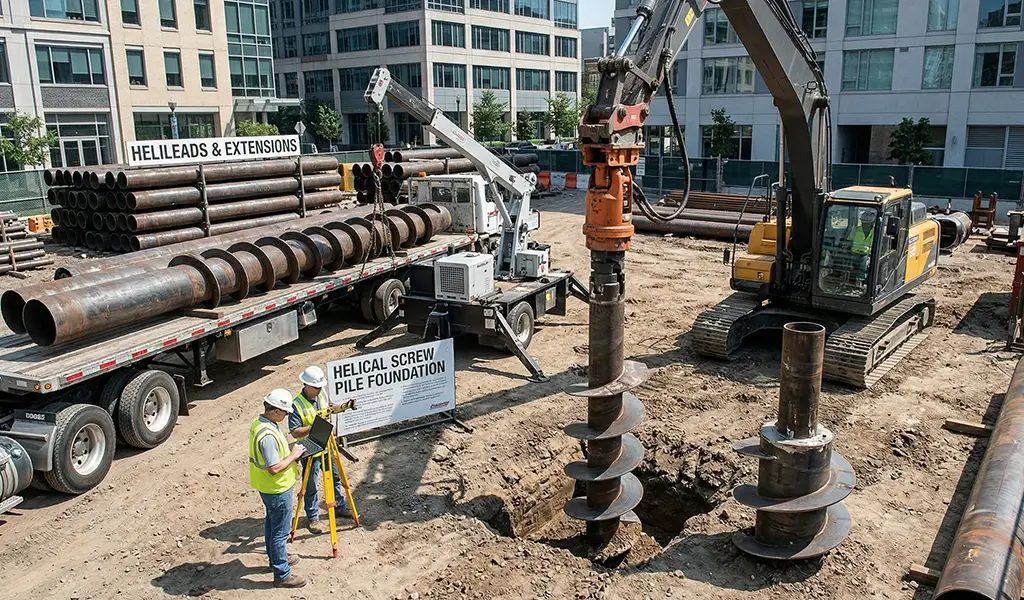
When traditional driven piling is impossible due to noise restrictions, limited access, or vibration concerns, engineers turn to the screw pile foundation. Also known as helical piles or helical piers, these specialized deep foundation systems are essentially massive structural ground screws designed to transfer structural loads deep into load-bearing soil.
While the helical bearing plates (the "flights") do the cutting, the structural integrity of the entire foundation relies entirely on the central steel pipe shaft. If the shaft yields during installation or fails under compressive load, the foundation fails. At All Steel Pipe, our distributors supply the high-yield structural tubing and pipe that helical pile manufacturers rely on.
1. The Anatomy: Round vs. Square Shafts
Screw pile manufacturers utilize two primary geometries for the central shaft, each serving a distinct engineering purpose:
- Solid Square / Square Tubing (RCS): Often manufactured from ASTM A500 Grade B or C. Square shafts are highly efficient at transferring torque during installation and are commonly used in tension applications (like guy-wire tie-downs) or in harder, dense soils where maximum rotational force is required.
- Round Pipe Shafts: Usually specified as ASTM A252 Grade 2 or 3 or API 5L. Round pipe offers a superior section modulus, making it highly resistant to bending and lateral deflection. If the pile is going to be subjected to heavy compressive loads or lateral shear forces (such as supporting a commercial building column), round pipe is the industry standard.
2. The Torque-to-Capacity Ratio
The most critical metric in screw pile installation is the empirical relationship between installation torque and ultimate load capacity. As the hydraulic drive motor twists the pile into the earth, the resistance (measured in foot-pounds of torque) correlates directly to how much weight the pile can support.
This is where steel quality becomes paramount. The pipe shaft must possess enough yield strength to withstand extreme rotational torque without experiencing "torsional buckling" (twisting or snapping like a drill bit). By utilizing heavy-wall A252 or A500 steel, installers can apply maximum torque, proving the pile's capacity before the foundation is ever poured.
| Specification | Geometry | Min. Yield Strength | Best Application |
|---|---|---|---|
| ASTM A500 Gr. C | Square Tubing | 50,000 PSI | High-Torque / Tension Loads |
| ASTM A252 Gr. 3 | Round Pipe | 45,000 PSI | High Compression / Bending |
| API 5L X52 | Round Pipe | 52,000 PSI | Extreme Torsional Resistance |
3. Displacement vs. Replacement
Unlike drilled shafts (caissons) which require augering and removing massive amounts of dirt (a "replacement" method), a screw pile foundation is a displacement method. The helical flights pull the pipe into the ground, displacing and actually compacting the soil around the shaft.
This provides two massive project advantages: there are zero soil spoils to export from the site (saving thousands in environmental disposal fees), and the pile can be loaded with structural weight immediately after installation, as there is no concrete curing time required.
Need Piling Pipe for Your Next Project?
All Steel Pipe is the premier technical resource for the foundation industry. Find verified ASTM A252, API 5L, and A500 square tubing distributors across North America.
View distributorsRelated Specifications
Need Processing for your Pipe?
Explore our fabrication and finishing services before it hits your job site.