
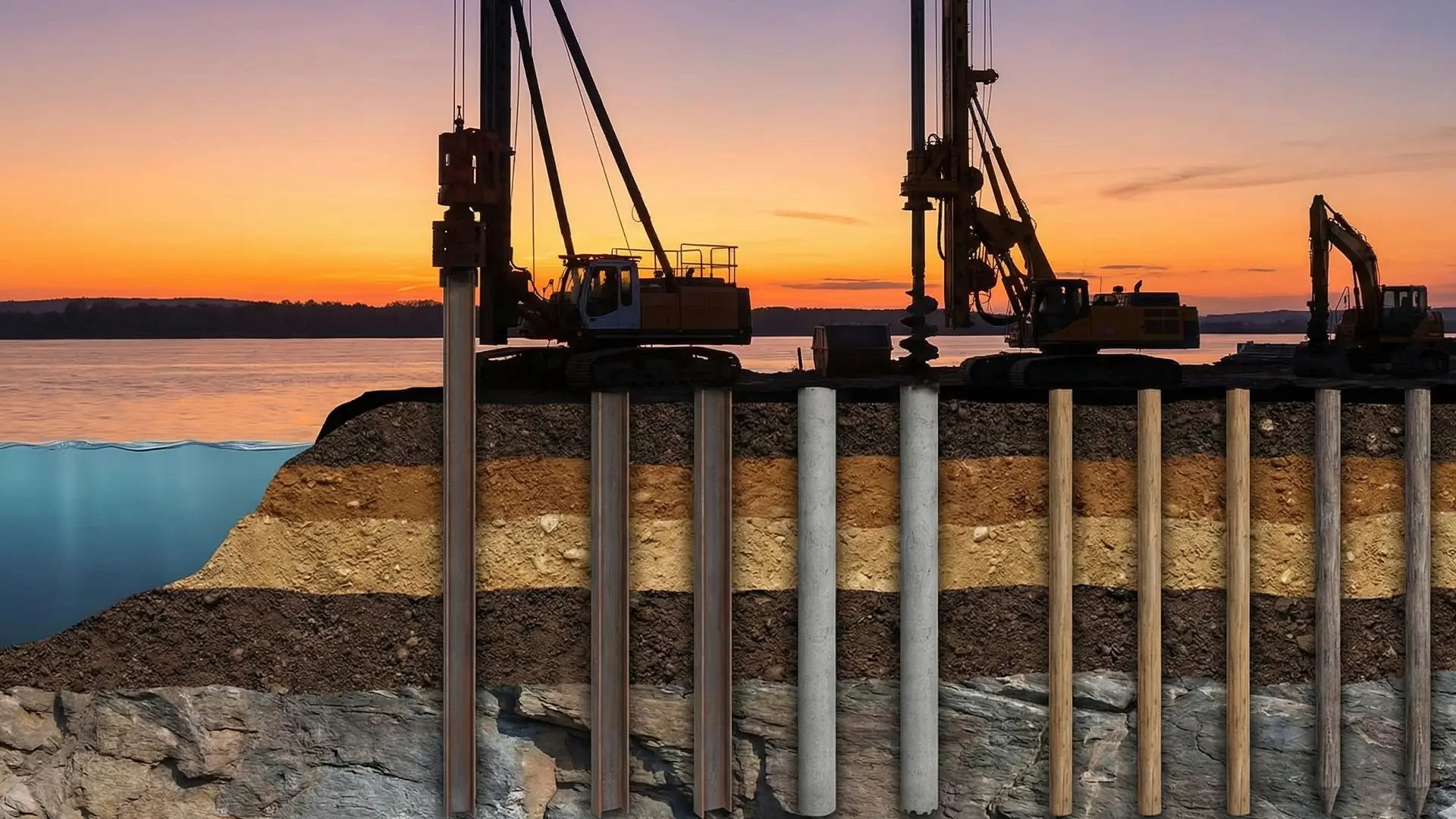
Deep Foundations are required when surface soil cannot support the structural load of a building. By transferring the weight to deeper, more stable rock formations or soil layers, piling prevents settlement and structural failure. Below are the common methods used in the industry.
1. Driven vs. Bored Piles
The two primary categories of piling are defined by how they enter the ground.
🔨 Driven Piles
Prefabricated elements (Steel Pipe, H-Pile, Timber, or Pre-cast Concrete) are hammered into the ground using a diesel hammer or vibratory rig. This method displaces and compacts the surrounding soil.
🕳️ Bored Piles
A hole is drilled into the ground (removing the soil), and the void is then filled with concrete and steel reinforcement.
2. Rotary Bored Piling
Used for larger diameter piles through hard or stiff strata. A temporary steel casing is often used to keep the hole open before concrete is poured.
Wet Boring
Used when the ground is water-logged. A temporary steel casing seals the pile against water entry. A digging bucket drills to depth, a reinforcing cage is lowered, and concrete is placed via tremie pipe.
Dry Boring
Similar to wet boring but used in stable ground conditions. Sometimes the casing is left in place permanently (Sacrificial Casing) to provide extra structural support.
3. Micropiles & Mini Piles
Micropiles (also called Minipiles) are small-diameter drilled and grouted friction piles. They are specifically designed for:
- Restricted Access: Areas with low headroom where massive pile driving rigs cannot fit.
- Urban Environments: Locations where the vibration from a diesel hammer would damage nearby structures or disturb the public.
- Underpinning: Reinforcing existing foundations that have settled.
Installation can be achieved via jacking, screwing, or drilling, followed by high-strength grout injection.
Which material is right?
Piling materials are available in various grades and sizes:
- ASTM A252: The standard for steel pipe piles (Grade 2 & 3).
- H-Piles: Dimensionally square beams for driving into rock.
- Sheet Piles: Interlocking sections for retaining walls.