
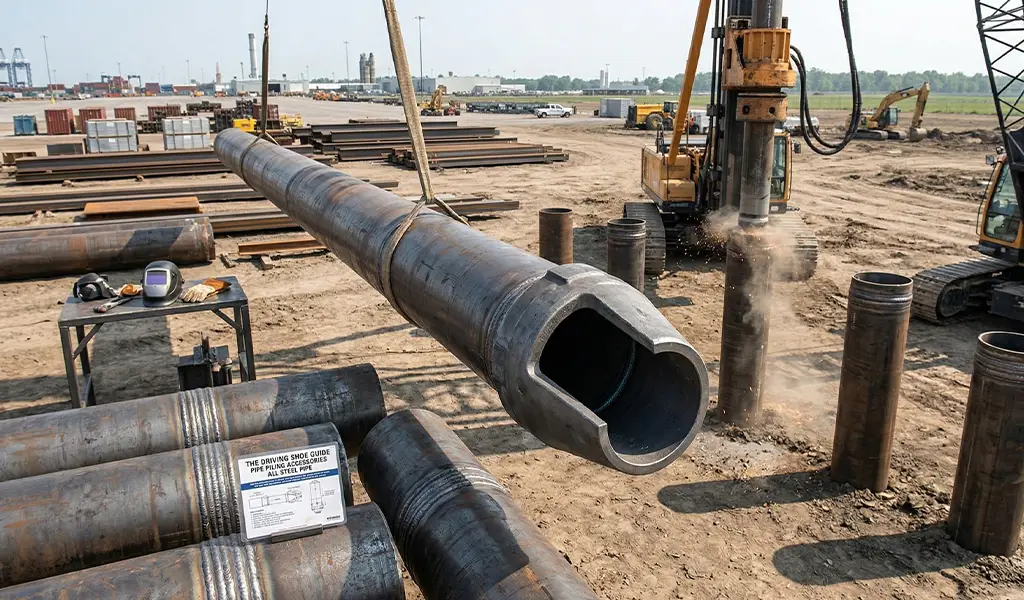
Driving thousands of feet of heavy-wall steel pipe into the earth is a violent, unforgiving process. When a pile meets unyielding refusal—such as bedrock, dense till, or submerged boulders—the unprotected tip of the pipe will warp, accordion, or completely collapse.
For estimators and geotechnical engineers, the soil report dictates the bid. If the boring logs indicate difficult driving conditions, simply ordering standard ASTM A252 steel piling is not enough to guarantee success. You must specify the correct cast steel piling accessory to protect the tip of the pipe and ensure it seats properly into the bearing layer.
In the heavy civil foundation industry, these protective accessories are generally broken down into three main categories: Conical Points, Rock Injectors, and Open-End Cutting Shoes. Here is how to choose the right one for your job site.
1. Conical Pile Points (Closed-End Driving)
When engineering specifications require a "closed-end" pile—meaning the pipe will remain hollow and be filled with concrete after driving—a conical pile point is the absolute industry standard.
How They Work:
A conical point is a heavy, cone-shaped piece of cast steel that is welded to the bottom of the pipe before driving. It acts exactly like the tip of a massive nail. The 60-degree point displaces the soil outwards as the pile is driven, preventing soil from entering the pipe while simultaneously distributing the driving impact evenly across the pipe's wall thickness.
Inside Fit vs. Outside Fit:
- Inside Fit (Friction): These points have a lip that slides inside the inner diameter (I.D.) of the pipe. The weight of the pipe rests on a ledge on the shoe. They are generally welded to keep them secure during driving.
- Outside Fit (Flanged): These points have a lip that slides over the outside diameter (O.D.) of the pipe. They are generally preferred for heavily battered (angled) piles where an inside fit might pop loose during driving.
2. Rock Injector Points (Extreme Refusal)
Standard conical points are designed for soil displacement. But what happens when the pile needs to toe into solid bedrock or penetrate a layer of dense glacial till?
The Bedrock Solution:
If you drive a standard 60-degree conical point into slanted bedrock, it will likely "skate" or glance off the rock face, causing the pile to bend out of alignment underground. A Rock Injector (sometimes called a Rock Point or H-Pile Point adapted for pipe) features high-strength "teeth" or a hardened, blunt nose designed to crush and grip the rock face.
This specialized cast steel shoe concentrates the entire impact energy of the diesel hammer onto a very small, hardened surface area, allowing the pile to chip into the rock and securely anchor itself without skating.
3. Open-End Cutting Shoes
Not all piles are driven closed. For massive large-diameter caissons or offshore structures, driving a closed-end pipe displaces too much earth, creating massive ground heave that can damage adjacent structures.
When to Specify an Open-End Shoe:
When engineering calls for an open-end pile, the earth is allowed to plug the inside of the pipe as it is driven (this soil plug is often augered out later). However, the raw, thin wall of the pipe still needs protection from rocks and debris.
An Open-End Cutting Shoe is a hardened steel ring (often cast with an inside lip) that is welded flush with the bottom of the pipe. The shoe is heavily beveled, creating a sharp cutting edge that slices through the soil while reinforcing the pipe wall against crippling and accordion damage.
Field Splicing Note: If your driven pile requires field extensions, do not rely on standard butt-welds alone. Specify internal Drive-Fit Splicers (also known as chill rings). These slip-fit sleeves align the two pipe sections instantly and provide a backing ring for a high-strength, full-penetration weld. Read our Structural Pipe Welding Guide for more details.
Specifying the Right Material
Whether you are dealing with HFW or DSAW steel pipe, the pipe itself is generally made to ASTM A252 (a carbon steel specification). However, your driving shoes must be harder than the pipe they are protecting. Always ensure your piling accessories are manufactured from high-strength cast steel (typically ASTM A27 or ASTM A148), not mild fabricated plate.
Find Piling Accessory Suppliers
Do you need ASTM A252 piling delivered to the job site with conical points already attached? Connect with fabricators who specialize in piling preparations.
View Piling Suppliers