
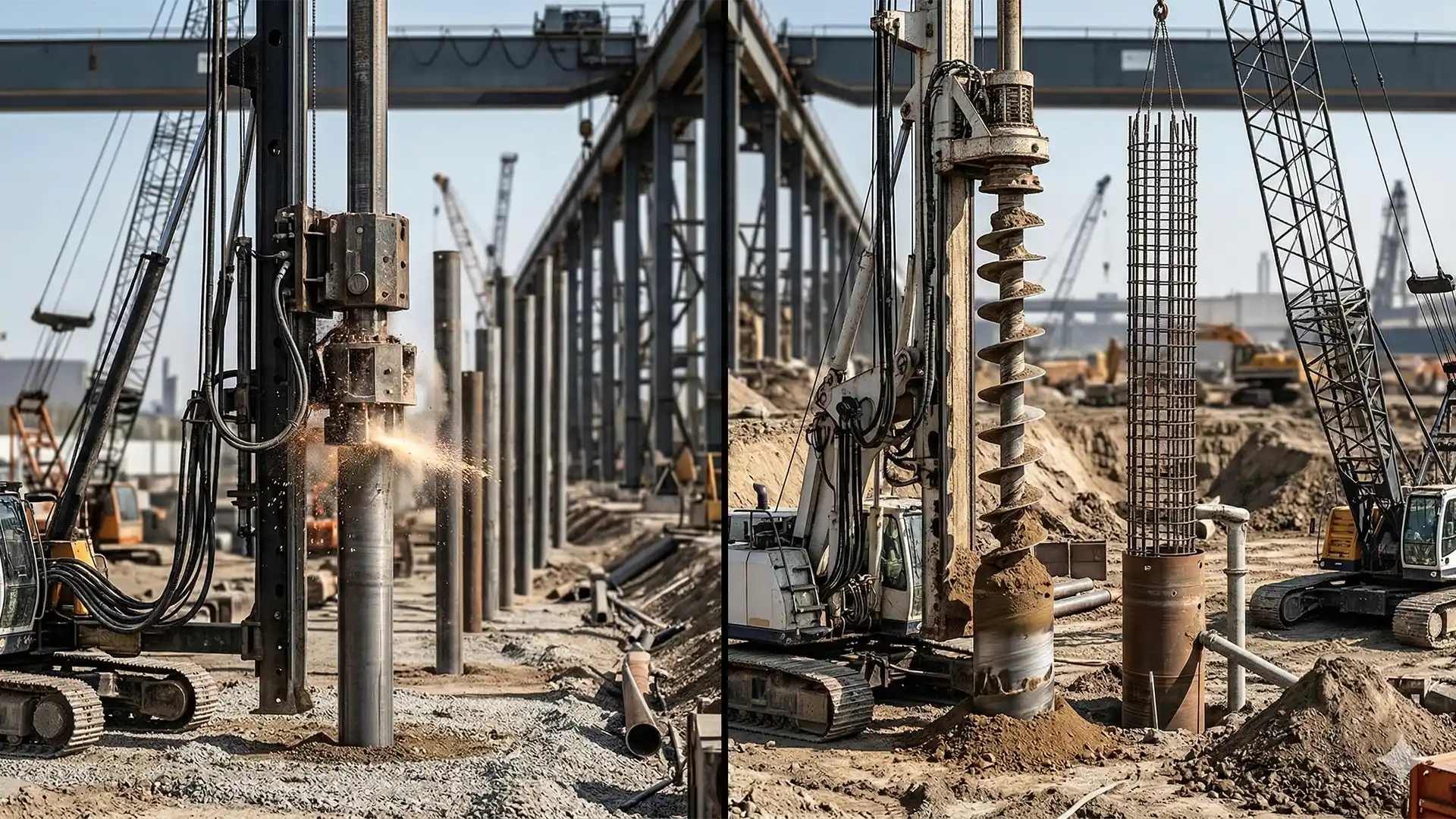
The foundation choice usually comes down to two main contenders: driving a pre-made element into the ground (Driven Piles) or digging a hole and filling it with concrete (Drilled Shafts). While both transfer structural loads to deeper, stronger soil layers, the mechanics of how they interact with the soil are fundamentally different.
Engineers classify this as the difference between Displacement (pushing soil aside) and Replacement (removing soil).
1. Driven Piles
Displacement MethodDriven piles—typically steel pipe, H-piles, or precast concrete—are hammered into the ground using a large impact or vibratory hammer. As the pile enters the ground, it displaces the soil, compressing it laterally.
Soil Improvement
Because they displace soil, they actually densify the ground around the pile, increasing friction capacity.
Built-in Q.C.
The pile itself acts as a test probe. Counting the hammer blows per foot provides real-time data on the soil's capacity.
Installation Speed
Driving is generally much faster than drilling, especially in wet or sandy soils where drilled holes might collapse.
2. Drilled Shafts
Replacement MethodAlso known as Cast-in-Drilled-Hole (CIDH) piles or Caissons, these are constructed by drilling a cylindrical hole, inserting a reinforcing steel cage, and filling it with concrete.
When to choose Drilled Shafts?
- Massive Loads are Required: A single large diameter shaft (e.g., 8-foot diameter) can replace a large group of driven piles, simplifying the pile cap.
- Vibration is Prohibited: In urban areas near hospitals or historic buildings, the vibrations from a pile hammer might be unacceptable. Drilling is significantly quieter and produces less ground vibration.
The Bottom Line
Cost Comparison
For small to medium loads, driven piles are typically cheaper per ton of capacity. Drilled shafts become cost-effective when the loads are massive enough to eliminate pile caps entirely.
Risk Profile
Driven piles offer lower risk because the structural element is manufactured and inspected in a factory before installation. Drilled shafts rely on concrete poured deep underground, making quality control (like CSL testing) critical.
Piling Suppliers
Locate master distributors stocking ASTM A252 steel pipe piling and A572 H-Piles near you.
View Directory