
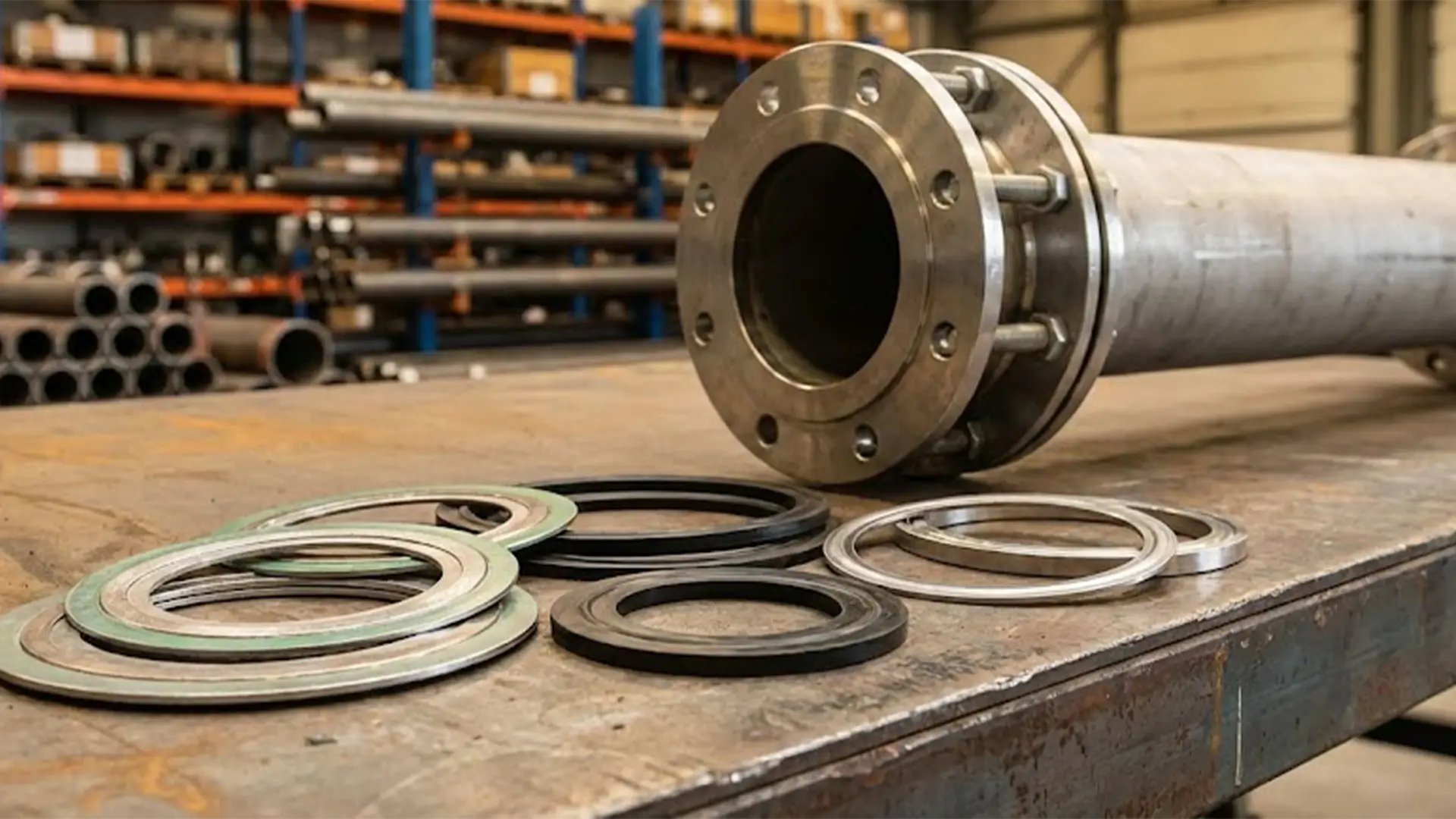
A flange joint is composed of three separate and independent, although interrelated components: the flanges, the gaskets, and the bolting. The Gasket is the material that fills the space between the flange faces to prevent leakage.
1. Spiral Wound Gaskets (Semi-Metallic)
The industry standard for high-pressure/high-temperature applications (Oil & Gas, Steam). They are made by winding a metal strip and a soft filler material together.
- Outer Ring (Centering Ring): Usually Carbon Steel (Yellow). Centers the gasket on the bolts.
- Sealing Element: Stainless Steel winding with Graphite or PTFE filler.
- Inner Ring: Prevents the winding from buckling inward into the pipe.
Color Codes:
- 🟡 Yellow Rim: 304 SS / Carbon Steel (Standard)
- 🟢 Green Rim: 316 SS (Corrosion Resistant)
- 🔘 Gray Stripe: Graphite Filler (High Temp)
- ⚪ White Stripe: PTFE Filler (Chemical Resistant)
2. Ring Type Joint (RTJ)
Used for extremely high pressure (Class 900 to Class 2500) connections. The gasket is a solid metal ring that is crushed into a groove cut into the flange face.
Oval Type
The original RTJ shape. Fits into both oval and octagonal flat-bottom grooves.
Octagonal Type
Provides a superior seal compared to the oval shape. Only fits into octagonal grooves.
3. Non-Metallic (Soft) Gaskets
Used for low pressure (Class 150/300) water, air, or low-temp lines. They are precision-cut from sheets of material.
- CNAF (Compressed Non-Asbestos Fiber): The standard replacement for old asbestos gaskets. Highly versatile.
- PTFE (Teflon): White material used primarily for harsh chemicals and corrosive environments.
- Red Rubber: A low-cost solution typically used for basic water lines and low-pressure utility systems.