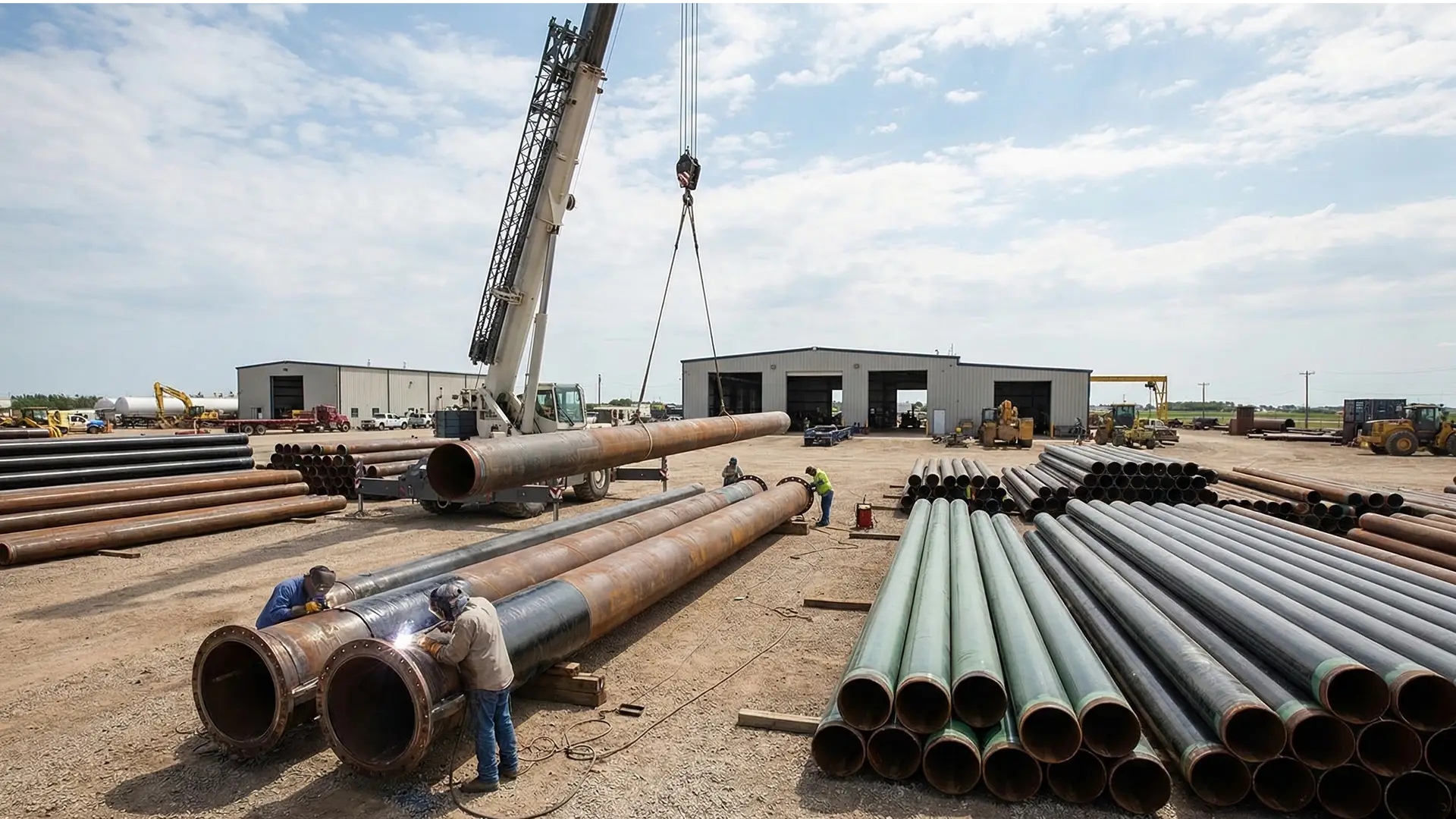
Ready-to-Drive Piling Solutions
Sourcing raw pipe is only the first step. A true deep foundation solution requires a finished structural element. Utilizing shop-fabricated components—from attached conical points to marine-grade coatings—allows contractors to significantly reduce field costs and installation downtime.
1. End Attachments & Protection
Driving into rock or dense glacial till often requires reinforcement. Ideally, attachments should be professionally welded in a shop environment to ensure consistent quality and prevent tip deformation during driving.
Conical Points
Cast steel 60° points used for penetrating rocky soil and distributing impact load.
Drive Shoes
Reinforced cutting rings (Inside or Outside fit) that protect the pipe tip during driving.
End Plates
Thick flat plates welded for closed-end piles (typically .750" to 1.50" thick).
Backing Rings
Internal chill rings provided for faster alignment and welding in the field.
2. Splicing & Fabrication
While standard truck lengths are 40ft to 60ft, deep foundations often require 100ft+ piles. Common fabrication specifications include:
- Double Jointing: Sub-arc welding two lengths together to create single pieces up to 80ft+ (shipping restrictions apply).
- Beveling: Precision 30° bevels are standard for quick field splicing.
- Lifting Lugs: Custom pad eyes or lifting holes cut to rig specifications.
3. Coating & Lining
For marine environments (docks, piers, jetties), corrosion protection is vital. Industry-standard protection methods include:
- Coal Tar Epoxy: High-build abrasion-resistant coating for splash zones.
- Galvanizing: Hot-dip galvanizing for smaller diameter pipe piles.
- Tape Wrap: Petrolatum tape systems for splash zone protection.
Fabrication & Services FAQ
Common questions regarding the preparation of steel pipe for deep foundation projects.
Conical Points (60°) are essential when driving into rock or soil containing boulders. They help center the load and fracture obstructions. Flat Plates are typically used for closed-end friction piles in softer soils (sand/clay) where the goal is to fully displace the soil to maximize capacity, rather than penetrate hard strata.
An Outside-Fit shoe has a larger diameter than the pipe, cutting a hole slightly bigger than the pile shaft. This reduces side friction (skin friction) during driving, making it easier to reach deep bedrock. An Inside-Fit shoe sits flush with the outer wall, preserving skin friction capacity but offering less protection to the pipe wall during driving.
While suppliers can double-joint pipe to almost any length, transportation is the limiting factor. Standard flatbed trucks accommodate up to 45-50 feet. Stretch trailers can haul up to 80 feet in many jurisdictions. Anything beyond 80 feet typically requires specialized "steerable" trailers and extensive oversize permits, which can significantly increase freight costs.
Structural welding for piling is generally governed by AWS D1.1 (Structural Welding Code – Steel). For critical projects, engineers may require partial or full penetration groove welds, often verified by ultrasonic testing (UT) or radiographic testing (RT) to ensure the splice can withstand the high-strain impact of the driving hammer.
It is expected that a portion of the coating will be abraded, especially near the tip and in abrasive soils. However, high-build epoxies (like coal tar) are designed to withstand significant shear forces. Often, engineers specify coating only for the top portion of the pile (the "splash zone" and upper soil layers) where oxygen levels—and therefore corrosion risk—are highest.
The industry standard is a 30° bevel (+5°/-0°). This creates a 60° included angle when two pipes are butted together, providing optimal access for the welder to lay the root pass and subsequent fill passes. A "land" (flat face) of approximately 1/16" is usually left at the bottom of the bevel.
While not strictly mandatory if the welder is highly skilled, backing rings are highly recommended for field splicing. They serve two purposes: they assist in aligning the two pipe sections quickly, and they prevent "icicles" (weld melt-through) from dropping inside the pipe. This speeds up fit-up time significantly, which reduces expensive rig downtime.