
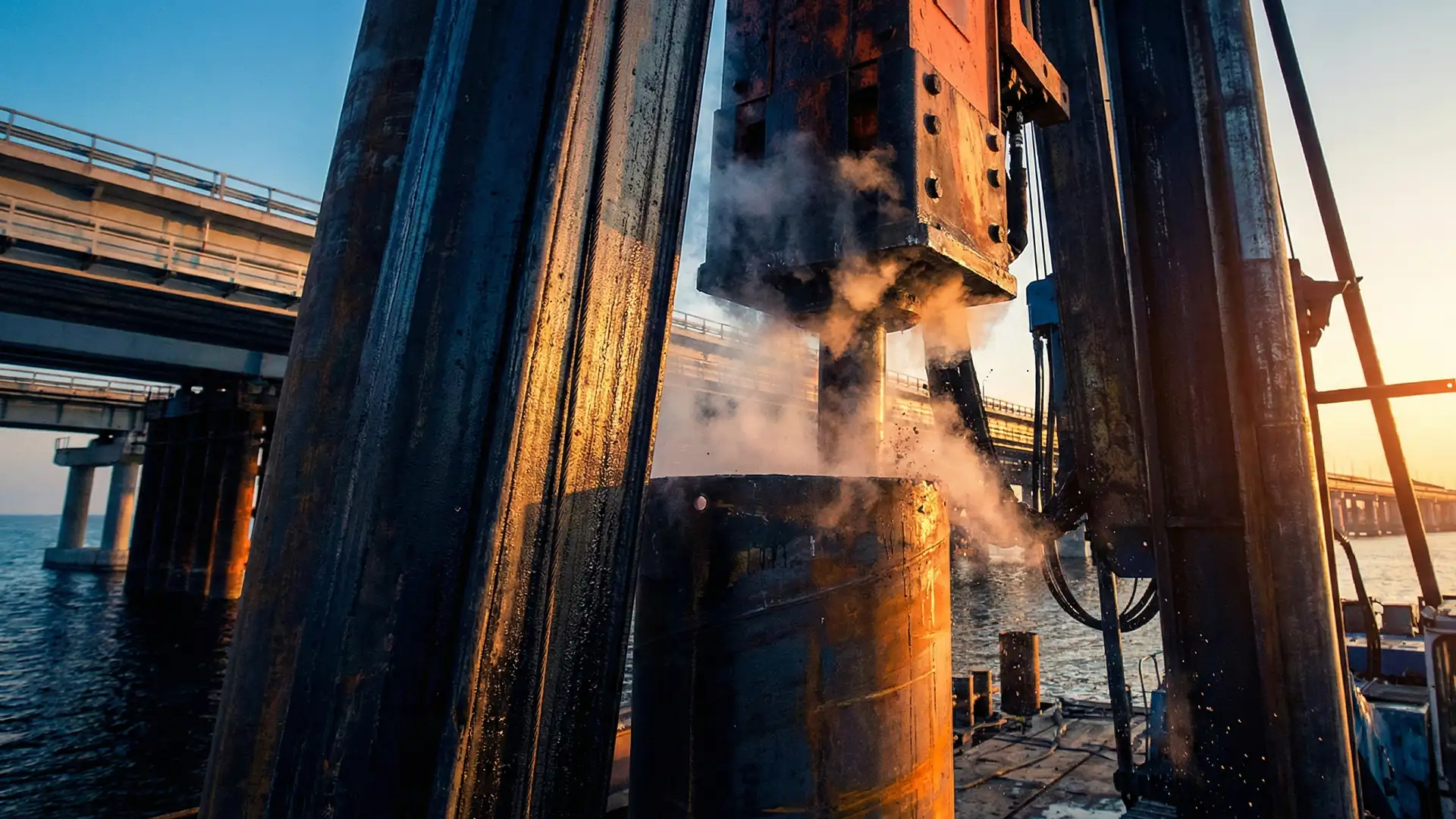
Piling is the core process of establishing a deep foundation. While shallow foundations rely on surface-level soil, piling transfers structural loads deep underground to competent soil layers or bedrock.
The Foundation System
Deep foundations are typically required when the upper soil strata are too weak to support a building's weight. Steel pipe piling is the industry standard for this task due to its high strength-to-weight ratio and ease of splicing.
How Pile Driving Works
Unlike drilling (which removes soil), pile driving is a displacement method. It forces a structural element into the earth, compacting the surrounding soil and creating additional friction-based capacity.
The Diesel Pile Hammer
The Diesel Hammer is the workhorse of the piling industry. It operates as a large, self-contained internal combustion engine that uses a heavy ram to strike the top of the pipe.
Load Transfer Mechanisms
One of the most common misconceptions about piling is that the pile simply "sits" on rock at the bottom. In reality, steel pipe piles transfer load through two distinct mechanisms:
1. End-Bearing
The tip of the pile rests directly on a hard layer of rock or dense gravel. The load travels down the steel pipe column and transfers directly into this hard stratum, much like a pillar standing on a concrete floor.
2. Skin Friction
Often, bedrock is too deep to reach. In these cases, the pile relies on "skin friction." As the pile is driven, the soil grips the outer surface of the steel pipe. The cumulative "grip" of the soil along the entire length of the shaft supports the structure.
Open-Ended vs. Closed-Ended Piles
Steel pipe piling offers a unique advantage over concrete or timber because it can be driven in two configurations, depending on the soil conditions:
- Closed-Ended: A conical point or flat plate is welded to the bottom. This fully displaces the soil and provides maximum end-bearing capacity. It is ideal for loose sands where you need the pile to "float" on friction.
- Open-Ended: The pipe is driven without a bottom covering. Soil enters the pipe (creating a "soil plug") as it descends. This makes driving easier in very dense soils because there is less resistance at the tip.