
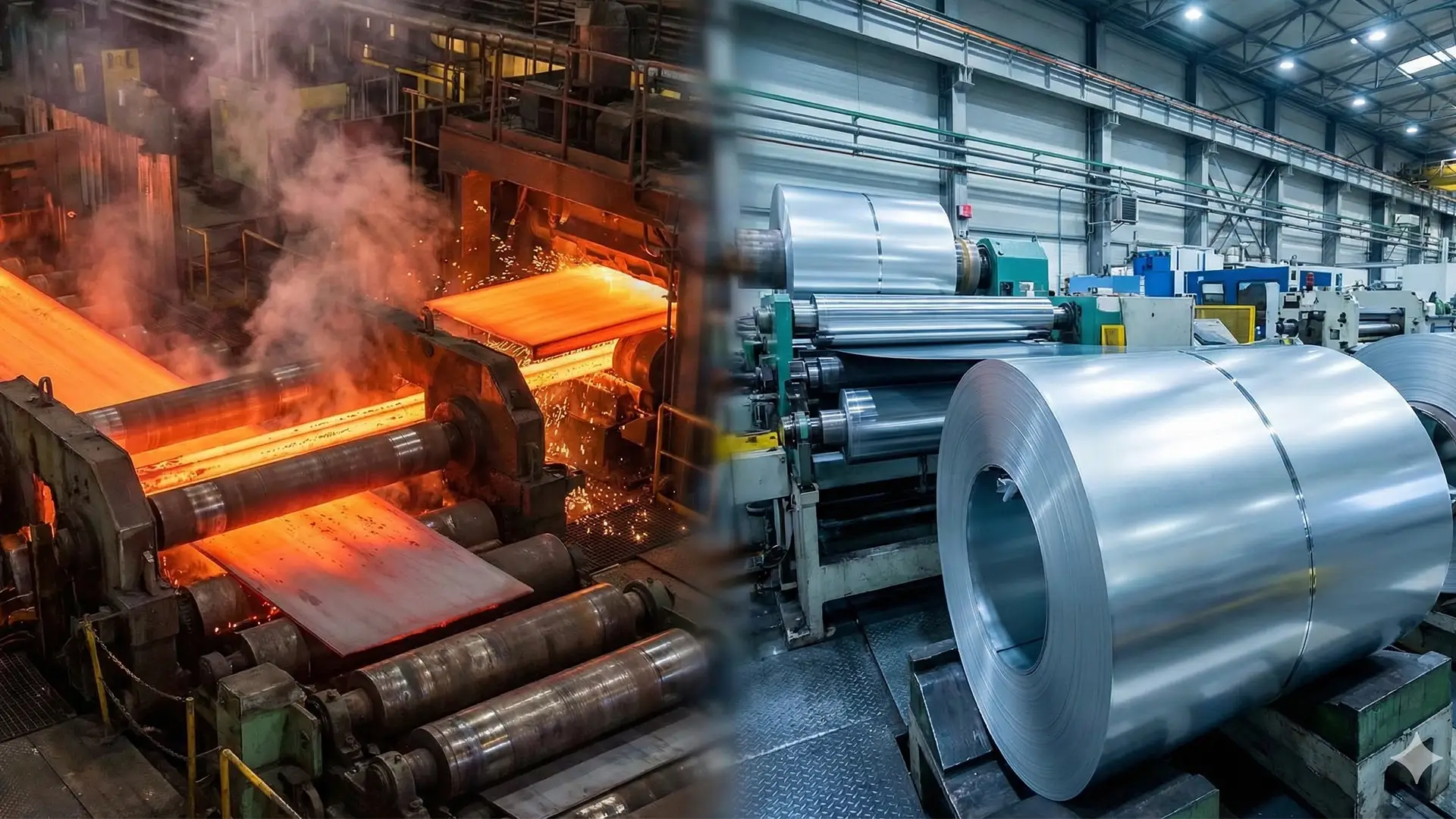
When buying steel pipe or tubing, the manufacturing process—Hot Rolled (HR) vs. Cold Rolled (CR)—determines the price, the finish, and the dimensional accuracy. Knowing the difference can save you significant money on your project.
1. Hot Rolled Steel (HR)
"The Industrial Workhorse"
Hot rolling involves rolling the steel at temperatures above its recrystallization temperature (over 1,700° F). Because it is processed hot, it is easier to form and cheaper to produce.
- Appearance: Scaly, dark blue/grey finish. Rougher to the touch.
- Tolerances: Looser. As the steel cools, it shrinks slightly, making exact size less precise.
- Best Use: Structural components where surface finish doesn't matter (Piling, I-Beams, Standard Pipe, Bollards).
2. Cold Rolled Steel (CR)
"The Precision Choice"
Cold rolled steel is essentially hot rolled steel that has gone through further processing. Once cooled, it is rolled again at room temperature to achieve exact dimensions and a better surface.
- Appearance: Smooth, oily, and shiny. Sharp edges and corners.
- Tolerances: Very tight. What you order is exactly what you get.
- Best Use: Applications where aesthetics or precision are key (Furniture, Automobiles, Handrails, Mechanical Tubing).
Comparison Chart
| Feature | Hot Rolled (HR) | Cold Rolled (CR) |
|---|---|---|
| Cost | Lower ($) | Higher ($$) |
| Surface Finish | Rough / Scaly | Smooth / Shiny |
| Strength | Standard | Higher (Work Hardened) |
| Typical Product | Structural Pipe, Beams | Precision Tubing |
Which do I need?
The Rule of Thumb: If it's going inside a wall, underground, or being painted for a fence, buy Hot Rolled and save money. If it's a visible handrail or machine part, buy Cold Rolled.
Find Suppliers →Technical Resources
Find a Supplier
Locate distributors stocking structural pipe and precision tubing near you.
View Directory