
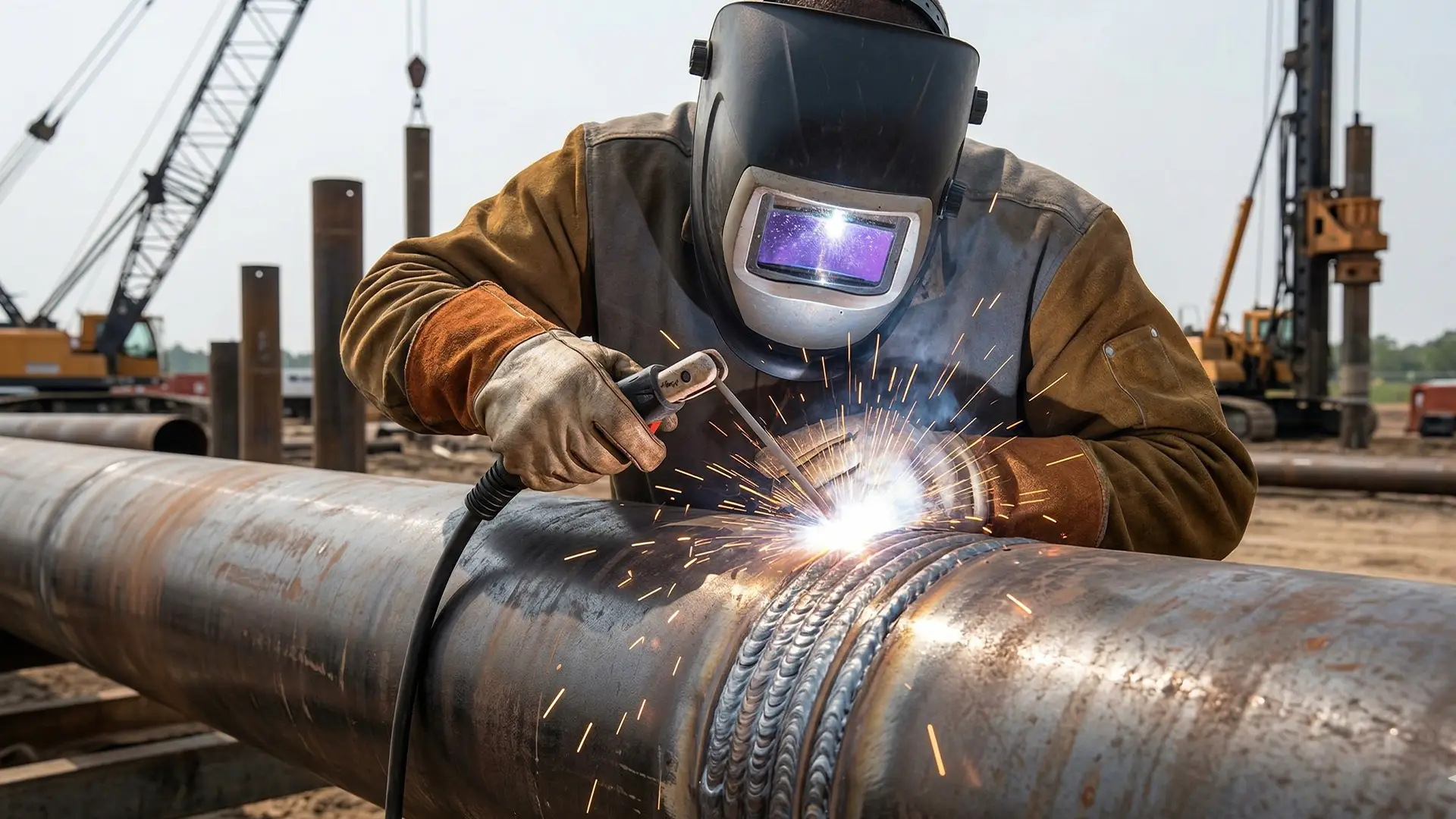
When engineering demands 100-foot friction piles but the closest rail spur only allows 60-foot loads, you have a field splicing problem. For deep foundations, creating a seamless, high-strength connection between two pipe sections is the difference between a secure structure and a total foundational failure.
Field splicing is a critical operation on any deep foundation job site. While ordering premium ASTM A252 steel piling ensures the material is sound, the structural integrity of the final driven pile rests entirely on the quality of the field weld. A weak splice can buckle under the massive blow of a diesel hammer or collapse under the lateral loads of the finished structure.
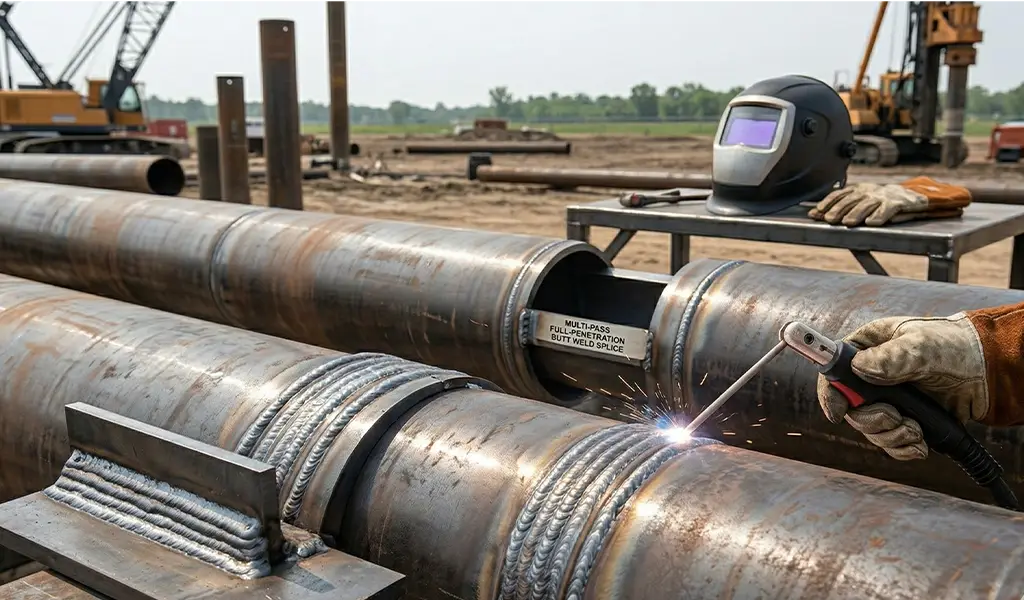
This guide provides the necessary technical framework for executing full-strength structural pile splices using the dominant industry methods: Butt Welding, Splicer Sleeves, and Chill Rings.
1. Joint Preparation: The Foundation of the Splice
The most common reason for a failed splice isn't the welding process; it’s the preparation. If the joint isn't engineered for penetration, the weld will only sit on the surface.
Regardless of the method used, both pipe ends must be prepared according to the established **Welding Procedure Specification (WPS)**.
Required Steps:
- Cleaning: All mill scale, rust, paint, moisture, and debris must be ground away for at least one inch from the edge. This prevents weld porosity and contamination.
- Beveling: For full-penetration welds, the pipe ends must be beveled (usually to a 30 to 37.5-degree angle) to create a "V" groove that allows the filler metal to penetrate the entire wall thickness.
- Alignment (Fit-Up): The two pipes must be perfectly concentric. Misalignment (high-low) creates stress concentration points and hinders uniform penetration.
2. The Essential Splicing Techniques
Here are the dominant methods used to achieve a structural field connection:
Method A: Full-Penetration Butt Welds (Standard)
This is the most common and robust splicing method. It involves aligning the two beveled pipe ends and executing a full-circumference groove weld. It provides a seamless connection capable of bearing full axial and bending loads.
However, executing a 100% full-penetration weld in the field without internal access is difficult. The welder must ensure the root pass successfully fuses the bottom edges without blowing through.
Method B: Drive-Fit Splicer Sleeves (Friction & Ease)
A specialized, friction-fit splicing alternative often used for smaller-diameter piles in difficult driving conditions (glacial till, boulders).
The Drive-Fit Splicer is a cast steel sleeve (image_122.png style) that has an internal "ledge." The ledge is friction-fit onto the O.D. of the driven pile. Driving energy is transferred *through the ledge* rather than the pipe wall, minimizing tip damage. The upper pipe is then set into the other side of the sleeve. While excellent for axial driving energy, these do not provide significant bending resistance unless also fillet welded.
Method C: Chill Rings / Backing Rings (High Strength)
When engineering demands 100% full-penetration fusion and verifiable integrity, **Chill Rings** are specified. A chill ring (or backing ring) is a split steel band inserted into the I.D. of the joint before alignment.
It provides a solid metal "backing" for the root pass, allowing the welder to aggressively ensure full penetration of the beveled edges *without* risking blow-through. This method creates the strongest, most inspectable structural connection possible in the field.
Welding Procedure Specification (WPS): All structural pile splicing must be performed by a qualified welder using procedures that meet AWS D1.1 (Structural Welding Code—Steel). This is particularly critical when dealing with the heavy wall thicknesses of **[DSAW steel pipe]**. Refer to our definitive **[API vs. ASTM Grade Comparison]** to ensure your filler metal chemistry is compatible with the chemical composition of the pipe itself.
Verifying the Splice: Quality Control
Driven piles are inaccessible for inspection once they are in the ground. The splice weld is the one location where integrity can be verified before driving continues. All structural splices should undergo quality control. A visual inspection (looking for consistency, undercut, or porosity) is mandatory, but critical infrastructure projects often require Non-Destructive Testing (NDT) such as Magnetic Particle Testing (MT) or Ultrasonic Testing (UT) to verify subsurface fusion.
Find Piling Fabrication Specialists
Do you need a supplier who can pre-attach driving shoes and chill rings before the piling hits the job site? Connect with top-tier fabricators now.
View Fabricators