
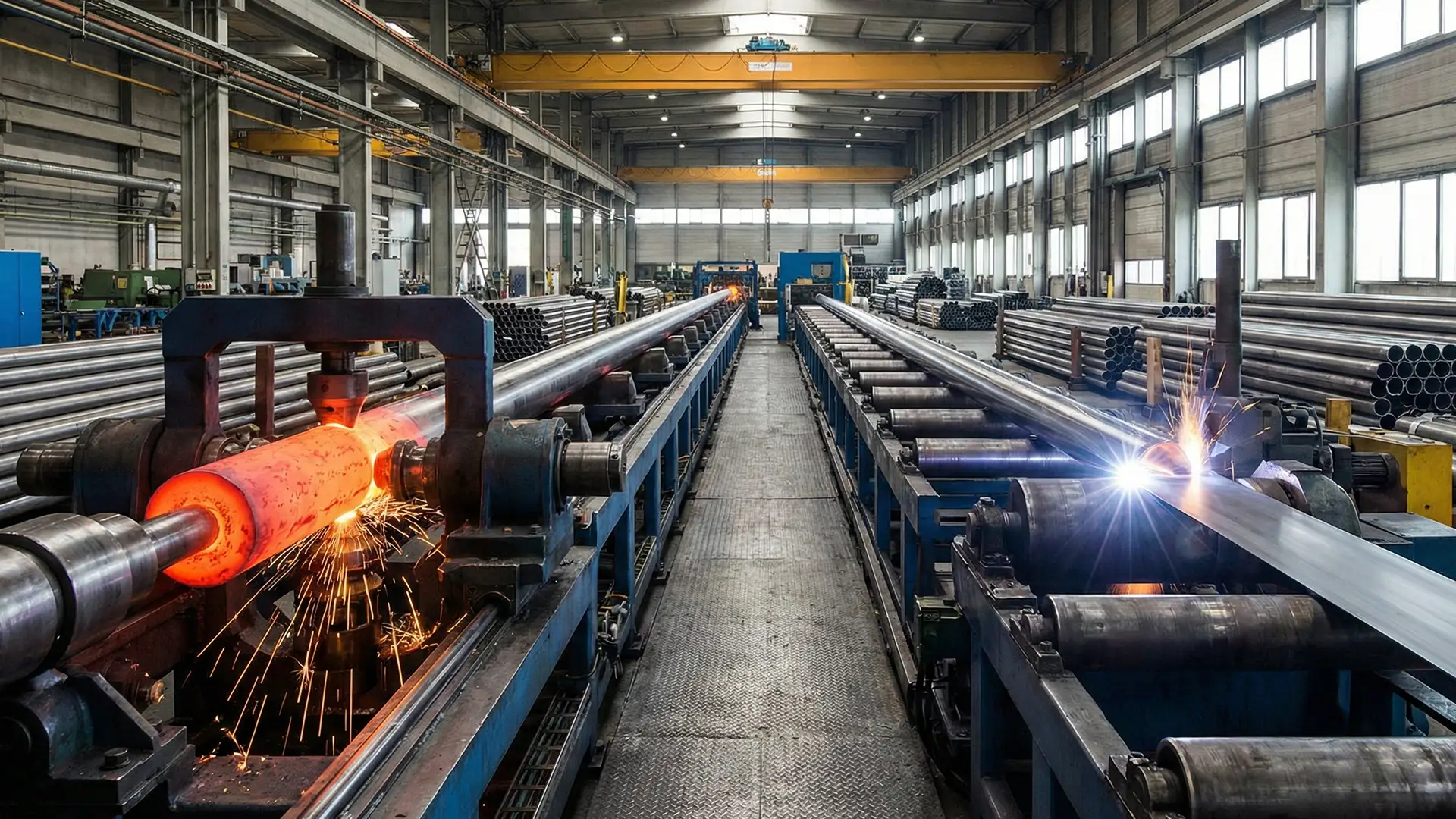
While many people use the terms "Pipe" and "Tubing" interchangeably, they are distinct technical products. Pipe is generally used to transport fluids and is measured by ID (Nominal Pipe Size). Tubing is used for structural or mechanical parts and is measured by exact OD (Outside Diameter).
If you need Pipe for water, gas, or steam (ASTM A53/A106), view our Seamless Pipe Page.
1. Pipe vs. Tubing
| Feature | Pipe | Tubing |
|---|---|---|
| Measurement | Nominal Bore (NPS) e.g., 2" Pipe = 2.375" OD |
Exact OD e.g., 2" Tube = 2.000" OD |
| Primary Use | Fluid Transport (Pressure) | Structural / Machining |
| Tolerances | Looser | Very Tight (Precision) |
2. Seamless Mechanical Tubing (A519)
Common Specs:ASTM A519 (Hot Finished or Cold Drawn)
Seamless tubing is used when the part requires heavy wall thickness or will be machined heavily. Because there is no weld seam, you can machine down the surface without hitting a "hard spot" or a hidden seam.
- Hot Finished Seamless (HFS): Rougher surface, lower cost. Good for heavy equipment bushings.
- Cold Drawn Seamless (CDS): Smooth surface, tighter tolerance. Good for hydraulic cylinders.
3. Welded Mechanical Tubing (DOM)
Common Specs:ASTM A513 Type 5 (DOM)
"DOM" stands for Drawn Over Mandrel. It is technically a welded tube, but after welding, it is drawn through a die to smooth out the seam. It is often used as a cheaper, lighter alternative to Seamless mechanical tubing.
- Advantages: More concentric (wall thickness is even all the way around), better surface finish, lower cost.
- Disadvantages: Still has a weld seam (even if invisible), roughly 15-20% weaker than a true seamless tube.